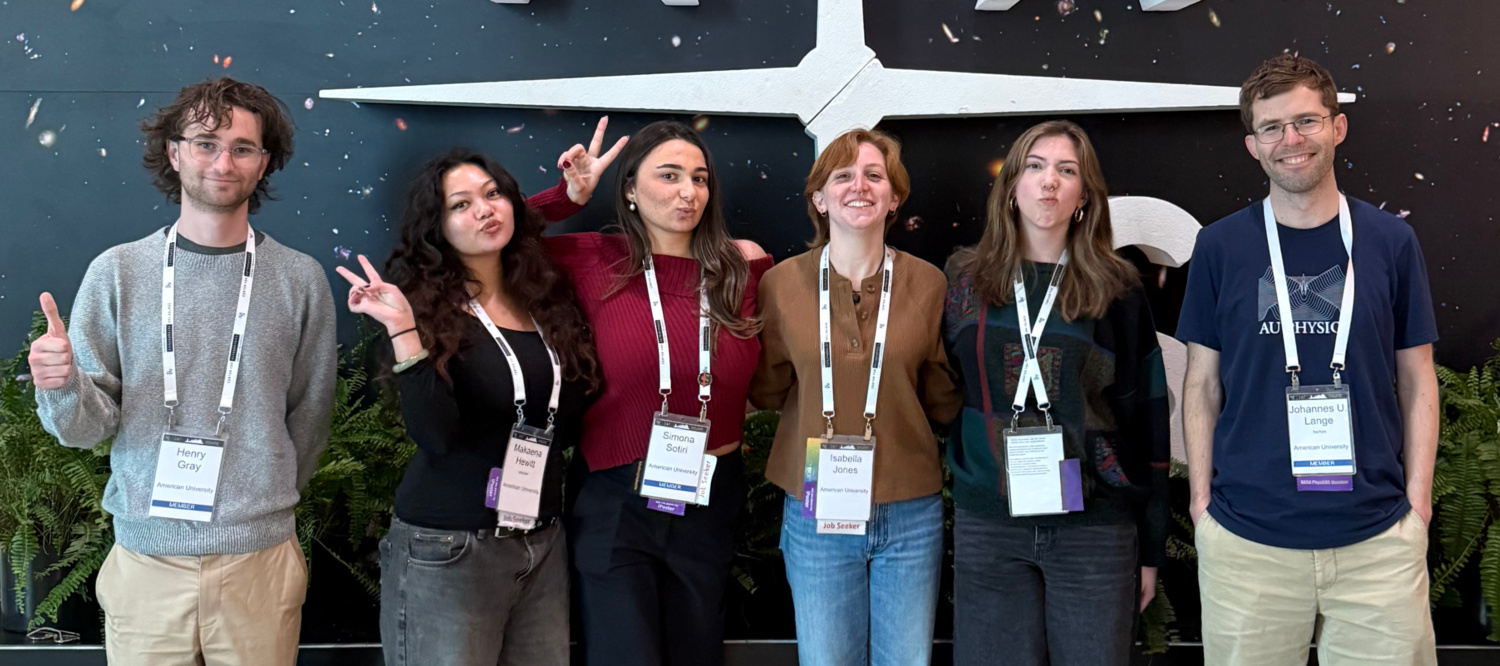
During my academic journey, I had the pleasure of mentoring a number of bright and curious undergraduate students on research projects. I’m always looking for new students working on projects in cosmology, galaxy formation, and machine learning. If you’re a student at American University and interested in research, don’t hesitate to reach out to me.
Current Students
Kimiko Queen
I joined as a rising junior while at American University. For our project, we focus on understanding why the observed gravitational lensing is weaker than predictions (“lensing is low”). I work with galaxies from the Dark Energy Camera All Data Everywhere project (DECADE) and the Baryon Oscillation Spectroscopic Survey (BOSS) surveys. I measure the galaxy-galaxy lensing amplitude, i.e. excess surface density, plot my findings, and interpret the results. I learned a lot about coding and it was an amazing experience working with Prof. Lange!
Abigail Fisher
Abby is an undergraduate physics student at American University researching weak gravitational lensing and photometric redshifts. Abby uses data taken with the Dark Energy Spectroscopic Instrument (DESI) to calibrate photometric redshifts in weak gravitational lensing surveys such as DES, HSC, and KiDS. In her research, she uses advanced computational methods and artificial neural networks.
Simona Sotiri
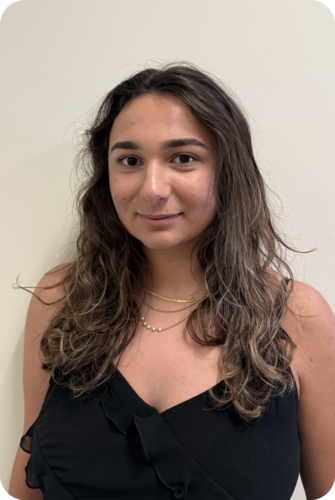
Simona, a senior at American University, is investigating to what extent measurements of gravitational lensing on small scales can be used to infer cosmology. To this end, she applies a Bayesian analysis of Halo Occupation Distribution (HOD) to simulated data from the FLAMINGO simulation. Her project builds open earlier work by Ali, Alex D., and Filomela, as described below.
Former Students
Henry Gray
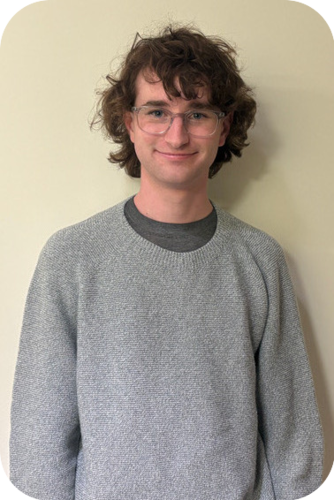
Henry joined as a junior while at American University. He was working with data from the FLAMINGO simulation, one of the largest, most accurate computer simulations of the Universe ever carried out. He used machine learning to study the properties of roughly a million galaxies in FLAMINGO. Specifically, he studied what properties of galaxies are most strongly related to an effect called halo assembly bias.
Alisun Coldiron
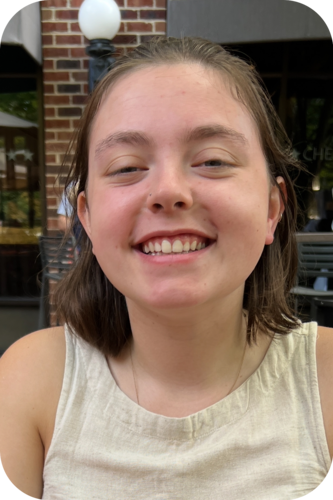
Ali joined as an undergraduate at American University investigating computer simulations of galaxy formation. Specifically, Ali analyzed data from the FLAMINGO simulation, a very large computer simulations of the Universe. Using machine learning, she studied the relationship between clumps of dark matter, so-called dark matter halos, and the galaxies that form within them.
Alexandra Wells
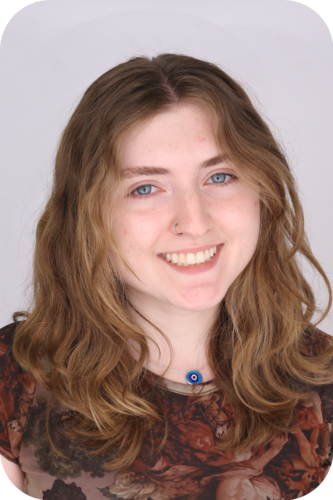
Alex was investigating how accurately we can determine the properties of dark energy and cosmic structure growth from measurements of the distribution of galaxies and gravitational lensing. For this work, we specifically focused on the measurements on small, so-called non-linear scales. She analyzed simulated “mock” observations constructed from cosmological simulations and tested how well we can recover the input values.
Alexandra Doytcheva
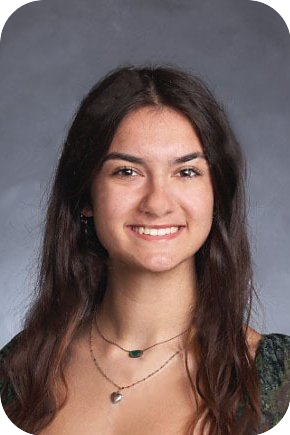
Alex joined the group as a first-year student. Initially, we investigated the relation between supermassive black holes and galaxies in the IllustrisTNG simulation. Later, we explored the use of control variates to increase the statistical precision of galaxy clustering predictions from hydrodynamical simulations. This work resulted in a paper with Alex and Filomela as the two lead authors.
Filomela Gerou
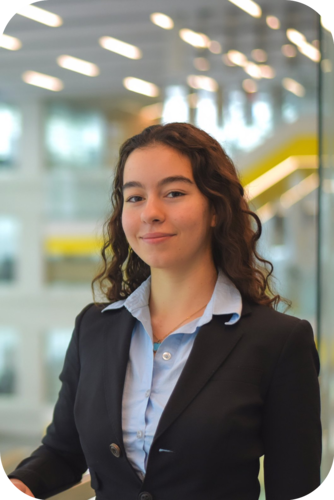
Filomela explored the relationship between galaxies and dark matter halos using neural networks. We investigated to what extend different halo properties can explain the galaxy assembly bias effect. Filomela also contributed to the project exploring the use of control variates to increase the predictive power of hydrodynamical simulations of galaxy formation.
Gilad Pifko
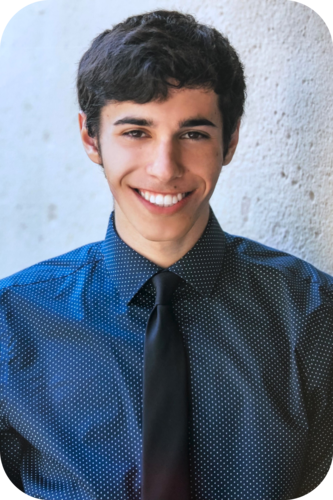
Gilad worked with data from the Kilo-Degree Survey, measuring the gravitational lensing effect, a prediction of Einstein’s theory of general relativity. He investigated whether the amount of dark matter surrounding galaxies depends on their size. He was able to confirm theoretical predictions from earlier studies in the literature.
Simon Wu
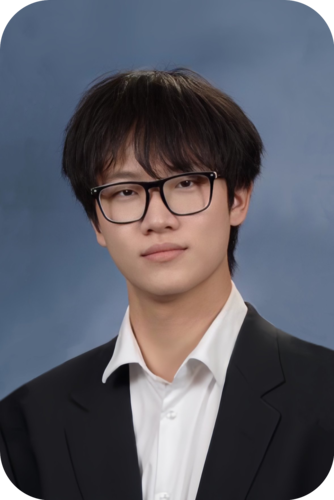
During our project, under the guidance of Prof. Lange, I focused on quantifying the contribution of dark matter subhalos to the gravitational lensing signal using the TNG300 hydrodynamical simulation. We explored the impact of satellite galaxies on galaxy-galaxy lensing, comparing different modeling approaches to assess subhalo contributions to the overall lensing effect. It was a great experience working on this interesting project with Prof. Lange and I really learned a lot!
Garv Shah
Garv studied the use of different neural network architectures for problems in Bayesian inference. Specifically, he investigated the performance of the nautilus code when using advanced networks he built with TensorFlow library. Ultimately, his results informed some design decisions for the widely-used nautilus code.
Juliana Karp
I investigated the causes of anisotropic satellite galaxy quenching (ASGQ) in two state-of-the-art cosmological simulations of galaxy formation, UniverseMachine and IllustrisTNG. I showed that ASGQ is probably not caused by outflows from the central galaxy’s supermassive black hole, but rather likely a natural consequence of hierarchical structure formation.